A Return to Japan: Excellence in the Details
Our family recently took a trip to Tokyo, primarily to attend a classical music concert. It was also our second visit to Japan within the past year, which is quite notable considering that before these trips, it had been nearly two decades since our last visit.
Coming back to Japan after so many years has been a reminder of what makes the country so distinctive. Japan feels orderly in a way that is immediately noticeable. The streets are clean, people are polite, and there is a strong sense of culture embedded in everyday life. What stands out most is the attention given to even the smallest details, no matter the setting. This is especially visible in culinary experiences, but it also seems to reflect a much broader cultural mindset.
That drive for excellence in every detail is a sharp contrast to some other cultures I have experienced, where the emphasis is often on the big picture, sometimes at the expense of finer execution. In Japan, the approach feels far more systematic and deliberate. That observation aligns with what I have seen in research and engineering as well.
I have long been fascinated by how culture can shape technical thinking. Years ago, I heard an example about routing a bandgap voltage across chips in pursuit of pristine accuracy. Some might question whether that level of precision is always necessary from a purely practical standpoint, but it reflects a mindset that values refinement and completeness. I was also reminded of a paper I referenced in my thesis, one that presented a remarkably symmetric circuit design. It was visually elegant and deeply harmonious, though not necessarily aligned with conventional topologies. Whether or not every design choice was optimal in a traditional engineering sense, it offered an interesting window into a culture that values balance, symmetry, and beauty alongside function.
That same sensibility is easy to feel while simply walking down the street in Tokyo. The weather during our visit was pleasant, hovering around 15°C, and cherry blossoms lined the sidewalks. There was a sense of order and tranquility that made even an ordinary walk feel memorable.
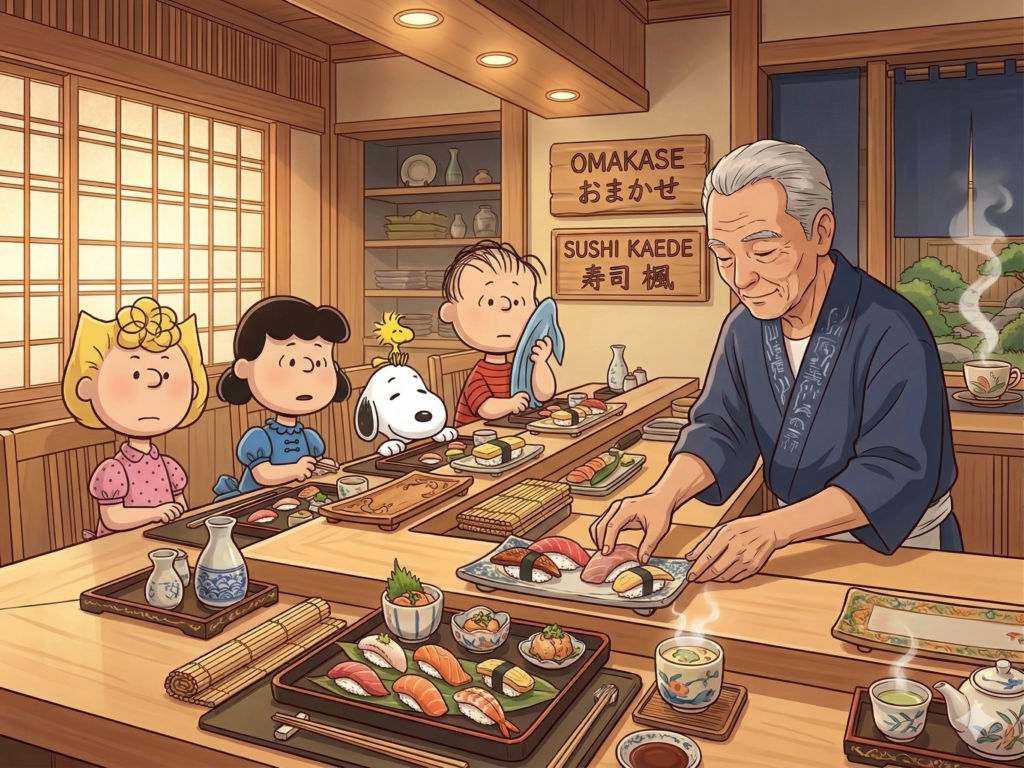
And of course, no family trip of ours is complete without memorable food. This time, we went for an omakase lunch, where the chef decides the menu. The experience was a perfect example of Japanese attention to detail. From the preparation to the final course, everything felt intentional. The chef carefully explained the menu, the ingredients, and the thinking behind the sequence. It was not just a meal, but a holistic experience—meticulous, thoughtful, and gracious from beginning to end.
Trips like this remind me that excellence is not always about grand gestures. Sometimes, it is about how consistently and thoughtfully the smallest things are done. Japan continues to leave that impression on me: a culture where details are not secondary, but central to the experience.